Meta

The news, movie trailers, infographics... these things provide information. They're meta. A recent trend is on meta-meta (such as lists of lists). In the case of these below, the information uses the very same equation (system, method) used in the meta (the movie trailer is in the movie trailer style, the news is told in the reporting style and the infographic is an infographic). Now if only we could get a pop song that just had lyrics like "I'm a tool and will do anything for money, you like me, so give me your money 'cuz you're worthless." It'll happen.

Note: Because most of these methods actually work, people do not often realize what it is that's doing the working on them. By using a method to explain a method, it is like showing a person the invisible arrow in the FedEx logo. Once they see it, they always see it. Need to get some people to use politics to show the method behind the illusion they're spinning. Onward... enough words...


by Phil Gyford


Feel free to leave others in the comments.
...It'll likely end up on this list.

Eviction Notice


"Eviction Notice" by Megan Kennedy (FallenIdle)

Dear Mrs. Singleton,

I'm sure you don't remember me. I may have been one of many students who felt the sting of your proverbial whip, past and present; I may be the only one. I'll never know. You may even be dead by now, and for that, speaking ill of the dead will no doubt upset a balance I'll have to right at some point. I accept this, because I am done giving your teeth a place to rest in my dying body.

Being as old as you were, I'm sure you'd long forgotten what it was to be a child, and how badly things in society had changed since your day, when people were actually afraid to get divorced and kids didn't come home to an empty house. No doubt, this effected your ability to understand that some students in your classroom were far less fortunate than others, in ways they didn't cause or comprehend, and adjust your sensitivity accordingly. Or maybe you were just at the end of your crotchety old life and had stopped giving a shit.

But my secrets are done being kept. Whatever your reasoning, you have to leave me.

I can't remember the name of the book, now, that you were reading aloud to the class. But I was 100% sure that at some point, you uttered a word that I'd gotten my mouth washed out with soap for saying; something not meant for 5th grade ears. I was scared, but my mother had always taught me to tell the truth and if I was uncomfortable, to say something. That I had every right to stand up for myself, and she would always back me up if I believed in it.

I did the only thing a mind that little could think of: I went to your teacher, Principal Foote, and told him how upset I was. I remember walking into that big, dark office, shaking in my Power Rangers sneakers; it didn't help that Principal Foote was a lovechild between Merlin Olsen and a lumberjack. But he was a kind man; when I wrote a Fairy Tale about him years earlier for a class assignment, word reached him and he asked me if he could keep the story, he loved it so much. How would he react to this, though?

I told him what had happened. Sitting on the edge of the chair, squirming and fidgeting like I still do today, almost as if I'm afraid to stop moving lest I keel over and die, I told him what you had said and that I didn't think it was appropriate for a classroom. I remember saying that: "appropriate for a classroom". I didn't know if he felt like laughing or yelling. He knew I wasn't a troublemaker, because this was only the second time we'd met. I don't think he knew what to make of me.

Oh, but you did, didn't you? You made me out for what I was: A spoiled little shit trying to smear the good name and reputation of a dedicated teacher in the golden years of her career. A liar, a failure. An outcast. You screamed at me after Principal Foote called you into his office, shook your long skeletal finger at me and said "How dare you! How dare you accuse me of this!" And when my mom finally came (I still don't know who called her, or why), you yelled at her. You scolded her for raising such a disobedient daughter, for raising a liar. But my mom looked right at you and said, "She doesn't like attention. If she says she heard something, she heard something. Does she look like she's enjoying this to you?"

But you, Mrs. Singleton, you weren't about to be distracted with petty logic or rationality. No, you had a war to fight, a war against an eight-year-old girl bold enough to not be afraid of you. Did you even realize what a threshold all your students stood on, or had you forgotten in your long years as an adult? Because each and every one of us dangled over a vast canyon of darkness, and at any moment, our safety line could snap.

You had two roads before you that day: A defensive shield, an arrogant knee-jerk emotional response to show your horror at the accusation; or, you could slow down and consider that, perhaps, the entire exchange was a big misunderstanding. The class room is big, with so many distractions; maybe this little girl is just mistaken, and a few kind words and a promise that you'd never talk like that to students would fix everything. You chose the former, and you changed everything. So often I've cried, wondering what would have happened if you had chosen different.

It's not hard to break a child, Mrs. Singleton. It's not hard to make a child believe in an unreality of your creation, simply because it is what you want them to think, or because it keeps them quiet and complacent. But, as you must be aware, breaking a child's spirit and mind is easily the moral equivalent of beating or sexually molesting them; perhaps even worse, because the psychological signs disguise themselves much better than bruises or blood, and fester much deeper. I fear on the other side, you will find no hands to shake, congratulating you for your success, your resilience, your ability to handle dissent. For that I pity you, because then you must stand before whatever god and power is there, and explain exactly why you chose to break me. I hope that he shows you my life, shows you the consequences of my own choices based on the fear you put in me; not to blame you, for I chose my own path, but to fully illustrate to you the beauty of this universe and its flawless interconnectivity. For one thing I've learned is that many of us take for granted the ripple effect our actions take on others, and I've done my best to remember what power I have, the same power you abused so carelessly.

When you made me move away from the other children, because I was a 'distraction', you made me paranoid and sure I was meant to be alone. Your actions told me I wasn't good enough, and I believed you, because you were still an elder I was commanded to respect.

When you made me re-do papers with no direction as to what I did wrong, or graded me unfairly, you taught me that sometimes my sweat and smarts mean nothing, if a person in the right position of power chooses it to mean nothing. You should note that after this incident, I got the first non-As of my life, and after I had left you my grades returned to normal. Even a child can understand that.

When you denied me participation with my friends by keeping me in recesses to "search that book for what you thought you heard", or rejecting my applications to be in school plays, or stealing away the one dream I had to play in the Students vs. Faculty basketball game, a once-in-a-lifetime goal that you gave to students younger than me just to keep me out of it, you showed me that not only are authority figures wrong sometimes, but there is nothing preventing them from acting more childish than children. You showed that for me to trust another authority figure would be a stupid, stupid mistake; I trusted you, after all, at one point. And now, it's difficult for me to hold a job, because of how hard it is for me to be blindly obedient to even the slightest appearance of someone who thinks they have power over me. I have no problem obeying someone I trust, but once that's lost, I cannot in good conscience follow and relinquish my power to another, and society doesn't exactly understand that. So often I find myself in that same chair you had me in, being scolded for doing what I think is right, punished for standing up for something my apparently misguided brain mistook for being important. And how do I explain it to the husband depending on me when I have to report my failure? Does he understand when I tell him every instinct I had told me to fight? Are my instincts right, Mrs. Singleton? You hold the answer, because you took it from me that day, and I've never gotten it back.

When you made me cry in front of the class during a weekly meeting because I'd asked a classmate for time to play with my best friend alone, without her, you showed me true cruelty for the first time in my young life. You made me a social outcast, a joke, and the taunting that began after you threw me to the wolves would not end until I was forced into a mental hospital just to survive. You sold me out to pre-teens, Mrs. Singleton, kids trying to scramble their way to the top of the social ladder with everything they've got. And what do you do? You toss them a sacrificial lamb.

Your terror made me retreat inside myself, and I almost drowned in the darkness I found in there. I used to slice my arms open just to let some of it out, and relieve the pressure, and I will forever bear the scars and curious stares. I want you to feel that, too. I want to take you by your liver-spotted hand and lead you into eternally shadowed forest where that little girl ran away to, after you tore open her heart. I want to show you the beasts that stalk me, and the ones that I stalk; I want you to see the moon in here when it glows red and evil and turns the black oceans into a quiet mirror of blood and death. I want you to hear the monsters as they breathe, crawling closer and closer; I want you to hear your own hyperventilating as you wonder if they will reach you this time.

And when we emerge into a dark, cold city, I want you to feel the stares and laughs and taunts. I want you to hear all the terrible things they say about you, the wolves who smell your fear. I want you to feel them circling and snapping and drawing blood, a little at a time, as you cry and beg for mercy. Then you will scream as they drag you away. They rip you to shreds, and others rebuild you like a rag doll and pump you full of numbing drugs and send you stumbling like a zombie back out into the world. And you will never be as afraid as you are in that moment, even though the clouds gathering at your feet are still as dark as ever, and you know it isn't over. Now every god, prayer, devil, promise, lover, friend and dream has a dark secret buried in its belly. Now nothing is a true friend to you, because you understand how deep minds and truth and reality are; you know they have monsters, just like you do, and how do you trust a monster? How does anyone trust you? Are you here, Mrs. Singleton? Are you real? Did you know, this is all a foolish dream?

As you writhe in the arms of insanity I would tell you, this is not a punishment. This is an education, just like the one you gave me. Universally, truth has always been the most painful of all burdens to bear, and yours will be no different. And you can soothe yourself afterwards with all the stories of people who, no doubt, loved you till the end of their lives, thought you were an angel from god, and remember that all is not lost. It's true, Mrs. Singleton; all is not lost, nor is it simple to understand.

But before you go into that good night, I must implore you to take all your truths with you on your way out. Too long your disease, your fear, your terrible mistakes and ignorant arrogance have feasted away at my soul and pulled me back down into the darkness I've fought tooth, claw and nail to escape. And you are done. You chose to make yourself a part of a child's life, and you failed her.

The very least you owe her is a second chance.

I am the queen of this forest, and however dark it may get, these monsters are mine and mine alone. No longer will you rule them.

So take your claws and your hatred and be gone from my fucking mind. Because the sacrificial lamb you created is become the wolf, and she is done with your lies.


This work is licensed under a Creative Commons Attribution-Noncommercial-No Derivative Works 3.0 License.
Comics dot Com vs GoComics

Pearls Before Swine

2009 was the year that companies flocked to Web2.0 standards in hordes. If you somehow missed this, then you shouldn't be reading this blog. One of my favorite shifts was seeing my favorite comics move from the page of the newspaper to my email reader. In the world of comics outside the indiescene, there are really only two powers now: Comics dot Com and GoComics. Sadly, at least by the end of 2009, the real winner easily goes to Comics dot Com. They win on both the levels of content as well as on their Web2.0 features.

Content: Anyone familiar with Pearls Before Swine or Get Fuzzy should be glad to know that these are both hosted on Comics dot Com, as well as tons of other comics. The two comics that stand out as contenders in the GoComics audience are Non Sequitur and Calvin and Hobbes. Calvin and Hobbes is no joke. If any try and contest the fact that it is the best comic of all time, they will rightly be considered insane. Sadly, it's been on re-run mode for-e-ver... and while it never gets old... it ain't getting any newer. Now, onto the Web2.0 features that secure the win for Comics dot Com...

Embedding: See the comic at the header? You can see it because Comics dot Com allows people to embed their strips on their own sites. GoComics does not. That means Comics dot Com gets instant advertising from all who re-post their content, although they have no control over who is doing the re-posting. With GoComics, you would need to contact the syndication or owner of the comic before re-posting or risk copyright infringement and the possibility of losing your own blog. Also, Comics dot Com can track down where their comics have been featured (via trackbacks or by basic analytics). The embed feature, above all else, places Comics dot Com in the lead.

Full-Image Subscription: Both sites let users subscribe to a specific comic. However, GoComics only provides a link in their daily subscription and not the comic itself. The very point of subscribing is so that a reader can get their favorite content from all their favorite sites in a single place... or, at the very least, previews of the content. RSS is the build-it-yourself newspaper of the future. Comics dot Com wins out here as well as they provide the entire comic.

Search: Both sites have work left to do on their search engines. Remember that comic you love? That one you couldn't stop laughing about and wanted to show others? Well it's online now! Seriously. You can share it with everyone... you just gotta find it. It is actually easier to find the comic on Google Images on a DIFFERENT site than it is to find the one you are looking for on the actual site. However, Comics dot Com edges out in the lead again, as I'm not the only one who has been able to find the comic I was looking for using their search. Their user-based tags help as well, but an advanced search is needed for both sites. Soon... I'm hoping... soon.

Needless to say, GoComics is still the home to Non Sequitur, so I will check in with the site every three months to see if there have been any updates. Non Sequitur is the nearest replacement in our modern age for The Far Side. I should likely note, before you do any searches only to come up empty, that The Far Side has failed terribly at any Web2.0 push. Actually, in order to fail, one must first make an actual effort. The Far Side hasn't even made an effort. The splash page for their main site looks like it was made in 1996. No, really, you've gotta see it to believe it. Check It!

In closing, the major syndications are finally catching up to the viral web comics of the indiescene, such as Cyanide & Happiness and xkcd (to name but two of the thousands they must now contend with). It is good to see this competition forced on them. Competition is not only great for the consumer... but great for laughs!

Stick

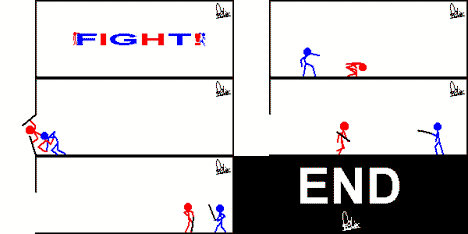
Stick Battles, Animated Graphics:

DragonBall StickGame Go!
Rotator
Kuronin Red versus Blue
Kill the Wall White versus Black

One of the first visual memes that was born of the Net were simple stick figure battles. They've come along way, thriving on the quick entertainment they provide and on the animation and psychology of fighting games. If it can be said that gratuitous violence exists in a world with no flesh, then the sticks are no exception. One great source of the most recent stick battles is StickPage dot Com. Here are a few of my own favorites:


Celebrating the Marlboro Monopoly Act

Marina
I thought I'd celebrate today with a very brief review of case studies on smokers, a bit of info on previous smoking bans and some random other tidbits. As of today, the Marlboro Monopoly Act (aka, the Family Smoking Prevention and Tobacco Control Act) has made all cigarettes containing these flavors illegal: (not menthol), strawberry, grape, orange, clove, cinnamon, pineapple, vanilla, coconut, licorice, cocoa, chocolate, cherry, and coffee. This is restricted only to cigarettes (wrapped in paper) and not cigars (wrapped in tobacco), so the clove industry (the only tested smoke with health benefits) has already begun making cigar versions of their clove products. This is also the beginning of a 12-year plan for the FDA to greatly reduce the amount of tar and nicotine in all American cigarettes at a slow rate.

The negatives are well-known at this point, so here are some positives that've gone without mention:

* Smokers are more honest than non-smokers (to the point where a commentator on the study referred to this as "abrasively honest"). [1]

* Smokers generally have an increased sex drive, 55% of aged 19-27 smokers being in sexually active relationships as opposed to 15% of non-smokers (the gap increasing as age does). [2]

* Smokers have an increased reaction-time (7% quicker), process information more quickly (21.65% quicker) and have improved short-term memory (5.76% higher retention). [3]

* A fifth of smokers only smoke four days out of the week. Men populate the majority of heavy smokers while women have less success quitting. [4]

* Most smokers believe smoking is worse for you than it really is, overstating health disorders and mortality rates. [5]


As to non-smokers, there is a long history of anti-smoking policies found most heavily in totalitarian governments. From the closure and burning of smoking cafes in Persia to early American 9-pin alleys, but the only one that beats out current U.S. policy is that of Nazi Germany. It should be noted that this most recent policy is nothing new, as America has trended more and more towards both Fascism and Communism for close to a century. Here are tidbits on anti-smoking from the master race:

* From Hitler, himself: "Tobacco is the wrath of the Red Man against the White Man for being given hard liquor." [6]

* Smoking was banned in all public places, government offices, shared living quarters and by any uniformed police and officers. [7]

* Smoking rose by almost 50% during the Nazi anti-smoking propaganda period. [8]

* Germany raised more than a billion Reichsmarks a year from 1937 to 1941, contributing to 1/12th of the funding used to build their army and launch the war. [9]

* "Passivrauchen" (trans. "Passive Smoking") was coined by the Nazi Anti-Tobacco League. Fritz Lickint, its author, gave no evidence to support its claim against environmental poisoning nor for the claim that coffee caused cancer, although both his statements were worked into Nazi propaganda. [10]

* The Nazi Reich Health Office produced posters stating that smoking was the filthy habit of Jews, Gypsies, blacks, intellectuals and Indians. [directly from preserved posters]


References:

1. "Smoking: The Artificial Passion", David Krogh
http://www.amazon.com/Smoking-Artificial-Passion-David-Krogh/dp/0716722461

2. "Smoking, Personality and Stress", Hans J. Eysenck, King's College, London, England
http://www.amazon.com/Smoking-Health-Personality-Hans-Eysenck/dp/0765806398

3. "Effects of nicotine and smoking on event-related potentials: a review", Pritchard W & Sokhadze E & Houlihan M., St Thomas College, New Brunswick, Canada
http://www.ncbi.nlm.nih.gov/pubmed/11498715 [summary]

4. "Individual Differences in Smoking and Nicotine Addiction", Saul Shiffman, University of Pittsburgh
http://www.drugabuse.gov/meetsum/nicotine/slides/21Shiffman/ShiffSlides.html

5. "Smoking: making the risky decision", "Patterns of Risk Perception", W.Kip Viscusi, Harvard

6. "Hitlers Tischgesprache im Fuhrerhauptquartier", Picker H., Bonn: Athenaum Verlag, 1951

7. "Die Genussgifte", Rauchverbot fur die Polizei auf Strassen und in Dienstraumen, 1940;36:59

8. "Smoking and death", Smith G D & Strobele S A & Egger M, BMJ1995;310:396

9. "Der Tabak, sein Anbau undseine Verarbeitung", Reckert FK. Tabakwarenkunde, Berlin-Schoneberg: Max Schwabe, 1942.

10. "Berlin: alcohol, tobacco and coffee", JAMA 1939;113:1144-5

Information on Marlboro's Family Smoking Prevention and Tobacco Control Act:
http://en.wikipedia.org/wiki/Family_Smoking_Prevention_and_Tobacco_Control_Act


Lastly, one more factoid on smokers: the majority of innovators, as well as early adopters, are smokers. With the heavy research going into locating, securing and maintaining a pool of innovators within each company, the profile of an innovator is very well known at this point. For my last three months before leaving my previous job, the top three performing agents in the world were all found most often in the forest outside the building smoking together. Rock! Here is one of the first studies that discovered this:

"Psychological characteristics of innovators", Abraham Pizam, European Journal of Marketing, ISSN:0309-0566
http://www.emeraldinsight.com/Insight/viewContentItem.do?contentType=Article&contentId=852555


Suicide Through Pleasure by ~Ally23 on deviantART

Happiness = Productivity

Excerpt from the article Top 10 reasons why happiness at work is the ultimate productivity booster...

Here are the 10 most important reasons why happiness at work is the #1 productivity booster.

1. Happy people work better with others. Happy people are a lot more fun to be around and consequently have better relations at work. This translates into:

* Better teamwork with your colleagues
* Better employee relations if you’re a manager
* More satisfied customers if you’re in a service job
* Improved sales if you’re a sales person

2. Happy people are more creative. If your productivity depends on being able to come up with new ideas, you need to be happy at work. Check out the research of Teresa Amabile for proof. She says:

If people are in a good mood on a given day, they’re more likely to have creative ideas that day, as well as the next day, even if we take into account their mood that next day.

There seems to be a cognitive process that gets set up when people are feeling good that leads to more flexible, fluent, and original thinking, and there’s actually a carryover, an incubation effect, to the next day.


3. Happy people fix problems instead of complaining about them. When you don’t like your job, every molehill looks like a mountain. It becomes difficult to fix any problem without agonizing over it or complaining about it first. When you’re happy at work and you run into a snafu – you just fix it.

4. Happy people have more energy. Happy people have more energy and are therefore more efficient at everything they do.

5. Happy people are more optimistic. Happy people have a more positive, optimistic outlook, and as research shows (particularly Martin Seligman’s work in positive psychology), optimists are way more successful and productive. It’s the old saying “Whether you believe you can or believe you can’t, you’re probably right” all over again.

6. Happy people are way more motivated. Low motivation means low productivity, and the only sustainable, reliable way to be motivated at work is to be happy and like what you do. I wrote about this in a previous post called Why "motivation by pizza" doesn’t work.

7. Happy people get sick less often. Getting sick is a productivity killer and if you don’t like your job you’re more prone to contract a long list of diseases including ulcers, cancer and diabetes. You’re also more prone to workplace stress and burnout.

One study assessed the impact of job strain on the health of 21,290 female nurses in the US and found that the women most at risk of ill health were those who didn’t like their jobs. The impact on their health was a great as that associated with smoking and sedentary lifestyles (source).

8. Happy people learn faster. When you’re happy and relaxed, you’re much more open to learning new things at work and thereby increasing your productivity.

9. Happy people worry less about making mistakes – and consequently make fewer mistakes. When you’re happy at work the occasional mistake doesn’t bother you much. You pick yourself up, learn from it and move on. You also don’t mind admitting to others that you screwed up – you simply take responsibility, apologize and fix it. This relaxed attitude means that less mistakes are made, and that you’re more likely to learn from them.

10. Happy people make better decisions. Unhappy people operate in permanent crisis mode. Their focus narrows, they lose sight of the big picture, their survival instincts kick in and they’re more likely to make short-term, here-and-now choices. Conversely, happy people make better, more informed decisions and are better able to prioritize their work.

This work is licensed under a Creative Commons Attribution-NonCommercial- ShareAlike 2.5 License.

Freedom to Fascism

Aaron Russo (February 14, 1943 - August 24, 2007), Academy Award winning film maker and beloved friend and manager to many actors and actresses, interviews many politicians, organizations and civilians to clarify the frauds perpetrated by an elite group against the American people for nearly a century, focusing on the Federal Reserve, World Bank, IRS and the upcoming RFID chip.

"The real rulers in Washington are invisible and exercise power from behind the scenes."
~Felix Frankfurter, U.S. Supreme Court Justice


There is a bill in the House at this very moment, put forth by Senator Ron Paul, to audit the Federal Reserve. Support actions such as these in your local and national government. If you are ever called to sit on a jury in a tax case, ask the judge to show you the exact law requiring a person to pay the tax and vote "not guilty" when the law cannot be shown (because it doesn't exist). Cases cannot be won when educated jurors sit on them. If you are ever audited, immediately make a Freedom of Information Act Request for the records that are being used to substantiate and justify the audit.

There is no such thing as a Democrat or a Republican. Obama, the current U.S. President, has already convinced world leaders to give 1.1-trillion dollars to the corrupt World Bank and is now giving the Federal Reserve direct powers over the corporate sector as well as giving them American tax money billions at a time. He is only a continuation of a long line of corrupt presidents. These institutions are the slavers:

The Federal Reserve
The Fraternity of the Skull and Bones
The Bilderberg Group
The Trilateral Commission
The World Bank/Central Bank
The International Monetary Fund
The World Trade Organization
The Bank for International Settlements
The Council on Foreign Relations
...and more

...and these are fighting the slavers!

NonTaxpayer dot Org
We the People Foundation
InfoWars dot Com
FreedomToFascism dot Com
...and many more

To make clear that these slavers understand what they are doing, here are the written words of Paul Warburg, who designed the Federal Reserve system and sat on the Council of Foreign Relations:

"We shall have World Government, whether or not we like it. The only question is whether World Government will be achieved by conquest or consent."

A far cry from the founding fathers and those who followed them. Here are quotes from both Lincoln and Jefferson talking out against this very system:

"If the American People ever allow the banks to control the issuance of their currency, first by inflation and then by deflation, the banks and corporations that will grow up around them will deprive the people of all property until their children wake up homeless on the continent their fathers occupied. The issuing power of money should be taken from the bankers and restored to Congress and the people to whom it belongs. I sincerely believe the banking institutions having the issuing power of money are more dangerous to liberty than standing armies."
~Thomas Jefferson

"The Government should create, issue, and circulate all the currency and credits needed to satisfy the spending power of the Government and the buying power of consumers. By the adoption of these principles, the taxpayers will be saved immense sums of interest. Money will cease to be master and become the servant of humanity."
~Abraham Lincoln


We find ourselves in a brief moment in the history of the world where information is free, widespread and transmitted near-instantaneously. This moment is ending. Obama, along with other countries, are placing the backbones--the infrastructure--of the Internet under government control, using cyberattacks and the War on Terrorism as their excuse to do so. Information will not be free for long. Spread it while you can. Get this message out and take the power away from those who seek our slavery.

This game is not over.